ORIGINAL STUDIES

Aim. To assess the features of clinical follow-up (dispensary observation) and the implementation of preventive measures among patients with prediabetes in the context of outpatient clinical practice.
Material and methods. The DIORAMA study (Features of dispensary observation and implementation of therapeutic and preventive measures in patients with “prediabetes” in outpatient clinical practice) is a multicenter, open-label, prospective, observational study planned to be conducted in 200 medical institutions across the Russian Federation, with up to 24,000 participants. The study will include adult patients with confirmed prediabetes (ICD-10 codes: R73.0 — impaired glucose tolerance and/or R73.9 — unspecified hyperglycemia, including impaired fasting glucose). The observation period will last for at least three years, with data collection at baseline, and at 1- and 2-year follow-ups. Data collected will include demographic, clinical, lifestyle anthropometric, laboratory, and instrumental parameters, as well as details on therapeutic interventions and their effectiveness over time. Additional tools will include the FINDRISC questionnaire and treatment adherence surveys. The primary endpoints are normalization of carbohydrate metabolism parameters and progression to type 2 diabetes mellitus (T2DM). Secondary endpoints include cardiovascular and all-cause mortality, incidence of myocardial infarction, stroke, acute coronary syndrome, and emergency myocardial revascularization.
Results. This study will examine real-world data pertaining to patients with prediabetes, focusing on patterns of care delivery — specifically, visit frequency and the deployment of therapeutic and preventive measures — and their effectiveness. The analysis is designed to evaluate laboratory parameters and modifiable risk factors, track progression to T2DM, and assess the influence of lifestyle, adherence, and therapeutic regimens on clinical endpoints.
Conclusion. The DIORAMA study is expected to provide, for the first time at the national level, a systematic overview of follow-up, therapeutic, and preventive measures for prediabetes in the Russian Federation. The findings will have high practical significance for developing organizational and methodological algorithms aimed at optimizing outpatient care, improving patient adherence to treatment, and reducing the risk of progression from prediabetes to T2DM.
Aim. To determine plasma concentrations of direct oral anticoagulants (DOACs) in patients with ischemic stroke (IS) associated with atrial fibrillation (AF) and to compare them with DOAC levels in patients with AF but without IS receiving similar therapy. Material and methods. A prospective cohort study was conducted at the Vascular Center of S.P. Botkin Moscow City Clinical Hospital from April 2022 to April 2023. The study included 82 patients with cardioembolic stroke on the background of AF (main group) and 130 AF patients without stroke or transient ischemic attack (TIA) (control group). All patients had been receiving DOACs (apixaban or rivaroxaban) for at least 3 months. Diagnostic workup included brain computed tomography, сarotid ultrasound, laboratory tests, and stroke severity assessment by NIH Stroke Scale (NIHSS). Plasma DOAC concentrations were measured by high-performance liquid chromatography-tandem mass spectrometry (HPLC-MS/MS). The lower limit of quantification (LLOQ) was 5 ng/mL.
Results. Patients in the main group had significantly more frequent subtherapeutic DOAC concentrations below the LLOQ compared to the control group (52.4% vs. 1.5%, p<0.001). Subgroup analysis revealed that 58.5% of patients on rivaroxaban and 41.4% of patients on apixaban had concentrations below LLOQ, compared to 2.5% and 0% in the control group, respectively (p<0.001 for both). Inappropriately reduced DOAC doses were observed in 45.1% of the primary group versus 19.2% of controls (p<0.001). Stroke severity assessed by NIHSS and mortality did not differ significantly between patients with DOAC concentrations below LLOQ and those with therapeutic levels. Patients with stroke had a higher CHA2DS2-VASc risk score, with a median of 6 points (p<0.001).
Conclusion. A significant proportion of patients with AF and cardioembolic ischemic stroke exhibit plasma concentrations of DOACs below LLOQ, which may contribute to stroke occurrence despite prescribed therapy. These findings emphasize the need to develop clinical criteria for selecting patients who require DOAC concentration monitoring and personalized therapy to reduce the risk of thrombotic events.
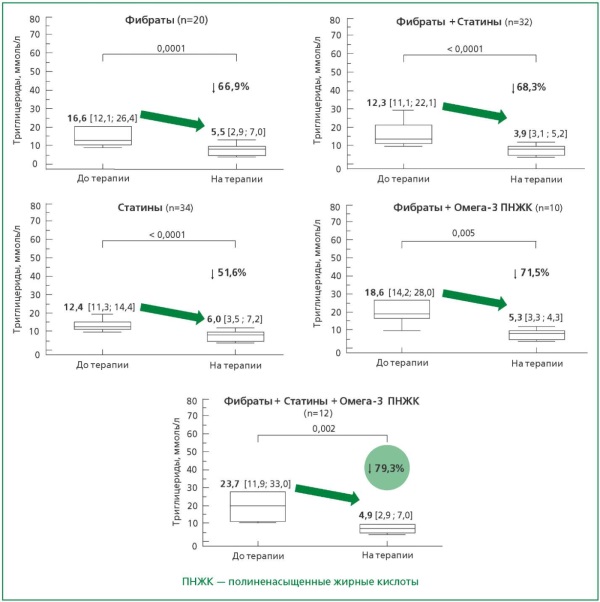
Aim. To evaluate the prevalence, clinical features, and effectiveness of various lipid-lowering therapy (LLT) regimens in patients with extreme hypertriglyceridemia (EHTG).
Material and methods. A retrospective analysis of a database comprising 170,640 patients from a cardiology inpatient unit and outpatient clinics was conducted (2018-2024) to identify cases of EHTG. The study included 155 patients with triglyceride (TG) levels exceeding 10 mmol/L. Twenty-three patients receiving cascade plasmafiltration were excluded from the analysis of pharmacological therapy effectivenesse. The final analysis of the efficacy of various LLT regimens was performed in 114 patients with maintained treatment adherence. Clinical characteristics, lipid profiles, over a follow-up period of at least 12 months were assessed.
Results. The prevalence of EHTG was 0.1%. The median age of patients was 50 [43-59] years, with 62% being men. The frequency of risk factors was as follows: obesity (58%), arterial hypertension (64%), type 2 diabetes mellitus (44%), and smoking (41%). A history of acute pancreatitis was present in 41% of patients, and pancreatic necrosis in 18%. Coronary artery disease was diagnosed in 56% of patients, with its onset preceding hyperlipidemic therapy (HLT) in 92% of cases. Atherosclerosis of carotid and lower limb arteries was detected in 52% and 55% of patients, respectively. Initially, there was a significant elevation in triglyceride levels (13.1 [11.3-26.4] mmol/L), while high-density lipoprotein cholesterol levels were low (0.8 [0.6–0.9] mmol/L). LLT resulted in a threefold reduction of TG levels to 4.2 [2.9–6.0] mmol/L. The highest treatment effectiveness was observed with a combination of fibrates, statins, and omega-3 polyunsaturated fatty acids (PUFAs), resulting in a 79.3% reduction in triglycerides; this was followed by a combination of fibrates with omega-3 PUFAs (71.5%). The smallest triglyceride reduction was recorded with statin monotherapy (51.6%). An analysis of the various regimens effectiveness also highlighted the importance of dietary adherence and lifestyle modification for achieving optimal results. A significant reduction in TG levels was revealed with combination therapy compared to monotherapy or no treatment.
Conclusion. EHTG is a rare condition (0.1%) but is associated with a high frequency of pancreatitis and atherosclerotic lesions. Combination therapy including fibrates, statins, and omega-3 PUFAs demonstrates the highest effectiveness in reducing TG levels.

Aim. To assess the Wnt1 and Wnt3a proteins levels in patients with stable coronary artery disease (CAD) and different phenotypes of coronary artery lesions.
Material and methods. A cross-sectional study included 72 patients with a verified diagnosis of stable CAD (aged 45-75 years) and 30 healthy individuals (control group) without cardiovascular risk factors. Based on coronary angiography or multispiral computed tomography, patients were divided into two groups. Group I — with non-obstructive coronary artery lesions (non-obCAD, n=30; including 11 men (37.5%); median age — 66.0 years [60.5; 71.5]; body mass index (BMI) 26.7 [25.5-30.2] kg/m²); Group II — with obstructive coronary artery lesions (obCAD, n=42; including 30 men (71.4%); median age — 64.0 years [57.0; 72.0]; BMI 27.4; [24.8; 29.8] kg/m²). The control group included 30 volunteers (10 men (33.3%); median age — 28.0 years [26.0; 37.0]; BMI 22.0; [20.9; 25.3] kg/m²). All patients underwent standard laboratory testing (complete blood count, biochemistry blood test, urinalysis) and instrumental diagnostics: electrocardiography (ECG), 24-hour Holter ECG monitoring, echocardiography, stress echocardiography and/or myocardial perfusion scintigraphy with a stress test. The levels of Wnt1 and Wnt3a proteins, endothelin-1, interleukins (IL-1β, IL-6), and C-reactive protein were determined by enzyme-linked immunosorbent assay.
Results. The CAD patient groups were comparable in age and BMI but differed in sex: the obstructive CAD group was predominantly male (71.4%), while females predominated (62.5%) in the non-obstructive CAD group. The level of Wnt1 protein was significantly higher in the obstructive CAD group (0.19 ng/ml) compared to both the non-obstructive CAD (0.15 ng/ml; p<0.001) and control groups (0.15 ng/ml; p=0.001). The level of Wnt3a was also higher in the obstructive CAD group (0.24 ng/ml) and the control group (0.25 ng/ml) than in the non-obstructive CAD group (0.11 ng/ml; p<0.001). Endothelin-1 levels were higher in the nonobstructive CAD group (33.5 pg/ml) than in the obstructive CAD group (27.3 pg/ml; p=0.027). Inflammatory markers (IL-1β, IL-6, CRP) did not differ significantly. Factor analysis revealed two main components: “lipid profile” and “endothelial damage” (Wnt1, Wnt3a, and endothelin-1). ROC analysis showed the second component had high prognostic ability for differentiating CAD phenotypes (AUC=0.987; p<0.001). A logistic regression model based on Wnt1 and Wnt3a demonstrated high accuracy (AUC=0.953) in identifying obstructive CAD.
Conclusion. The obtained data may suggest a possible role of the Wnt signaling pathway in the pathogenesis of different types of coronary artery lesions in CAD. Increased levels of Wnt1 and Wnt3a were associated with obstructive coronary artery lesions. An attempt was made to develop a regression model based on Wnt1 and Wnt3a concentrations. The resulting model has high diagnostic value for identifying patients with obCAD. This allows considering these proteins as potential prognostic biomarkers for risk stratification and clarifying the type of coronary artery lesion in CAD.
Aim. To assess the association between carrying CYP2C19 polymorphic variants and response to antiplatelet therapy, evaluated by residual platelet reactivity (Platelet Reactivity Units, PRU), in patients from different age groups.
Material and methods. The study included 140 patients with ACS receiving antiplatelet therapy with P2Y12 receptor inhibitors. The main group consisted of 70 patients aged 75 to 90 years (senile age), 35 taking clopidogrel, and 35 taking ticagrelor. The control group consisted of 70 patients aged 45 to 74 years (old and middle age), 35 taking clopidogrel, and 35 taking ticagrelor. The antiplatelet effect of therapy was assessed by studying non-stabilized whole blood using the VerifyNow point-ofcare assay. Carriage of the CYP2C19*2 and CYP2C19*3 alleles was determined using commercial reagent kits (Sintol LLC, Russia), and CYP2C19*17 was determined using commercial kits (Applied Biosystems, USA).
Results. The influence of CYP2C19 genetic variability on residual platelet aggregation was evaluated in elderly patients compared to patients of old and middle age. PRU values in the main group (senile age) (120.9 (48.5; 205.0)) on day 2 were statistically significantly higher (p=0.03) than in the control group (old and middle age) (96.06 (17.0; 174.5)). The same trend was observed in all subgroup comparison depending on the drug used: PRU values were statistically significantly higher in the main group of patients. Genotype distribution corresponded to the Hardy-Weinburg law for CYP2C19*17 and CYP2C19*2 except for CYP2C9*3. In control group patients receiving ticagrelor, carriage of the T allele (CYP2C19*17 locus) was statistically significantly associated with lower PRU levels (p=0.023). Furthermore, in the main study group among patients with PRU>208 receiving clopidogrel, carriers of the minor T allele at the CYP2C19*17 locus were statistically significantly more frequent (p=0.022) (CC genotype in 32% of patients, CT/TT genotypes in 80%).
Conclusion. Comparison of the main (senile age) and control (old and middle age) groups revealed that elderly age is associated with higher PRU values. A similar pattern was found when analyzing the main and control groups by subgroups depending on the drug taken: the proportion of patients with PRU values >208 was statistically significantly higher among patients from the main group (senile age). The obtained results regarding the carriage of the minor T allele at the CYP2C19*17 locus and PRU values in the main group could be associated with the phenomenon of phenoconversion, comorbidity, and polypharmacy in elderly patients.
Aim. To compare the efficacy of pulmonary vein radiofrequency ablation (RFA) in patients with atrial fibrillation (AF) between two temporal cohorts (2016-2018 and 2021-2022) and to identify factors affecting the likelihood of arrhythmia recurrence.
Material and methods. The study sequentially enrolled two patient cohorts. All patients underwent pulmonary vein RFA. The first cohort included 78 patients recruited between 2016 and 2018. The second cohort included 92 patients recruited between 2021 and 2022. The incidence of AF recurrence was assessed at 3, 6, and 9 months post-ablation. All arrhythmia recurrences and complications were confirmed by medical documentation. A range of factors potentially influencing AF recurrence was evaluated, including sex, age, body mass index, AF type, presence of atrial flutter, duration of AF history, echocardiographic parameters, comorbidities, procedural volume and duration, intraoperative electrical cardioversion, and antiarrhythmic drug therapy. Regression analysis with logistic regression equations was used to assess the impact of factors on endpoints. A p-value of 0.05 was adopted as the critical significance level.
Results. In the first cohort (2016-2018), the overall RFA efficacy was 65.4%, compared to 83% in the second cohort (2021-2022). Early recurrences were more frequent in the first cohort, while the second cohort exhibited more delayed arrhythmia recurrences. Belonging to the second cohort significantly reduced the risk of atrial fibrillation recurrence (OR 0.46, 95% CI [0.21; 0.97], p=0.04). Conversely, a history of myocardial infarction increased the recurrence risk (OR 12.08, 95% CI [1.46; 251.25], p=0.03). The overall complication rate included four cases of intraoperative hemopericardium and one cardioembolic stroke in the first cohort, and one case each of hemopericardium and cardioembolic stroke in the second cohort. No deaths occurred during the study period.
Conclusion. Modern RFA approaches (including earlier application of the procedure and accumulated surgical experience) provide high efficacy in treating atrial fibrillation. A history of myocardial infarction is an independent predictor of recurrence requiring enhanced monitoring. The obtained data confirm the importance of standardizing ablation timing and comprehensive assessment of cardiovascular risk factors.
PAGES OF RUSSIAN NATIONAL SOCIETY OF EVIDENCE-BASED PHARMACOTHERAPY

Aim. To analyze data on adverse drug reactions (ADRs) from medical history and assess pharmacotherapy (PT) adherence among patients within an outpatient registry. This study aims to investigate the relationship between these variables and determine their potential priority.
Material and methods. A cross-sectional study was conducted using data from the “PROFILE” outpatient registry, which included 2,619 patients with cardiovascular diseases (CVD) and associated risk factors from 2014 to 2024. Information on PT adherence and the history of ADRs was collected during physician consultations at the point of registry enrollment and recorded on individualized registration forms. ADR presence was assessed based on whether or not patients reported previous reactions. Patients were classified as adherent if they reported regular use of prescribed medications, partially adherent if they used medications irregularly, and nonadherent if they refused medication entirely. Patients not prescribed PT at the time of registry inclusion were excluded from adherence analysis.
Results. A comparative analysis was conducted between subgroups of patients based on the ADRs presence or absence in their medical histories. At the initial visit, ADRs were reported in 492 (18.8%) patients. Of these, three patients indicated they had not been prescribed pharmacotherapy. Among the remaining 489 patients, 365 (74.6%) were classified as adherent, 31 (6.3%) were nonadherent, and 93 (19.1%) reported irregular adherence. Only 9 (7.3%) out of 124 nonadherent individuals in this subgroup cited ADRs as the reason for their nonadherence.
Among 2,127 patients without ADRs in their medical histories, 36 indicated that PT had not been prescribed. Of the 2,091 remaining individuals, 1,397 (66.8%) were adherent, while adherence issues were identified in 33.2%: 428 (20.5%) refused medication, and 266 (12.7%) took medications irregularly. In this subgroup, only 7 (9.6%) patients attributed their nonadherence to concerns about ADRs. The primary reason for nonadherence in both subgroups was an unwillingness to follow long-term treatment regimens.
Multivariate logistic regression analysis identified five independent variables out of ten that demonstrated statistically significant associations with ADR presence: female sex (OR=1.67; 95% CI: 1.30-2.14; p<0.0001), older age (≥60 years) (OR=1.37; 95% CI: 1.03-1.81; p=0.029), the presence of chronic heart failure (OR=1.66; 95% CI: 1.27-2.17; p<0.0001), polypharmacy (≥5 prescribed medications) (OR=0.74; 95% CI: 0.56-0.98; p=0.037), and complete nonadherence to PT (OR=0.47; 95%CI: 0.29-0.74; p=0.001).
Conclusion. The data from the outpatient registry revealed that nonadherence was more prevalent among patients without documented ADRs in their medical histories compared to those with ADRs (every third patient versus every fourth). ADRs were shown to be a direct cause of nonadherence in less than 10% of cases. Patients who exhibit nonadherence to pharmacotherapy are more likely to have ADRs in their medical histories. Consequently, it appears that adherence takes precedence in the relationship between safety and pharmacotherapy: any deviations from prescribed regimens may lead to increased risks associated with medication use.

Aim. To demonstrate successful experience in the development and implementation of biobanking methods for epidemiological research in the Russian Federation (RF), as well as the application of biobanking technology and the participation of a biobank created on the basis of the national medical research center in conducting a large-scale epidemiological study. This aims to improve the efficiency and quality of its implementation, as well as to ensure the possibility of conducting prospective studies.
Material and methods. The study included interviews with participants, instrumental measurements, biomaterial collection, laboratory diagnostics, and database creation. The protocols of the second and third stages of the study included biobanking regulations for collecting biological material from the regions of the RF and delivering it to the central biobank.
Results. The establishment of the biobank in 2014 for the storage of biospecimens collected within the Epidemiology of Cardiovascular Diseases and their Risk Factors in Regions of the Russian Federation (ESSE-RF) study enabled the planning and implementation of subsequent large-scale epidemiological projects. In accordance with the developed and validated biobanking algorithm, samples of whole blood, serum, and plasma from a representative sample of different Russian regions were collected in a centralized biobank. Information on biological samples, blood donors, and laboratory tests of all participants was combined into a single database. In total, the biobank currently stores samples and data from 79,516 participants from 41 regions of Russia.
Conclusion. The inclusion of biobanking technology in the study protocol made it possible to conduct a large-scale epidemiological study in compliance with high quality standards. The resulting biomaterial collection is stored and actively used in prospective studies to analyze the dynamics of the prevalence of risk factors and non-communicable diseases, as well as to study the frequency of gene variants involved in various pathological processes.
CLINICAL CASE

In recent years, the results of numerous scientific studies have shifted the focus from phenotypic traits to genotype as the basis for the modern classification of primary cardiomyopathies (CMP). An example of this genotype-specific approach is CMP associated with variants in the MYBPC3 gene, which holds significant clinical relevance. One feature of this heart disease is significant phenotypic heterogeneity. Furthermore, there is high variability in the disease penetrance and expressivity, even among patients with the same MYBPC3 gene variant, which complicates risk stratification, prognosis determination and the personalization of therapeutic approach. This article presents a case of a family with a likely pathogenic MYBPC3 gene variant (rs727503195, c.1790G>A, p.Arg597Gln) in three generations. The described family case clearly demonstrates the significant heterogeneity in the CMP clinical and morphological characteristics associated with MYBPC3 gene variants.
ASSOCIATED PROBLEMS OF CARDIOLOGY

Aim. To define and discuss the main pathogenic mechanisms of polycystic ovary syndrome (PCOS) and its association with cardiometabolic risk factors.
Material and methods. The material for this nonsystematic review was collected from peer-reviewed articles published in PubMed, eLibrary.RU, CyberLeninka, and other research databases from 2006 to 2024 using the following terms: polycystic ovary syndrome, cardiometabolic risk factors, phenotypes, and cardiovascular diseases.
Results. Population studies suggest that the risk of hypertension and cardiovascular diseases is higher in the reproductive age group compared to the general population. An increased risk of cardiovascular diseases in younger individuals (children, adolescents) may be associated with maternal PCOS. The transition to menopause is likely not associated with a deterioration in the cardiometabolic profile, which may be linked to improvements in the phenotypic features of PCOS with age. Cardiometabolic risk varies depending on the PCOS phenotype, which may support a new classification approach to PCOS. Mendelian randomization studies indicate that it is not PCOS itself, but rather the associated factors (obesity, hyperandrogenism), that likely explain the epidemiological link between PCOS and cardiometabolic diseases. According to published international guidelines for the treatment of PCOS, women with PCOS should regularly assess their overall cardiovascular risk in order to individualize therapy.
Conclusion. Women with PCOS are at increased risk for cardiovascular diseases and cardiometabolic disorders compared to the general population. However, the degree of risk may depend on the PCOS phenotype and the stage of life. Further research is needed, including studies in different age groups (adolescents, reproductive age, menopause, postmenopause), to determine the most effective strategies for reducing the cardiovascular disease risk associated with PCOS.
The results of randomized controlled trials (RCTs) presented at the recent ESC Congress are being analyzed. A number of RCTs with similar objectives have yielded formally opposite results. This primarily concerns the effectiveness of beta-blockers in modern conditions after a myocardial infarction, as well as the possibility of replacing dual antiplatelet therapy with monotherapy with prasugrel or ticagrelor after a myocardial infarction. However, a thorough analysis of the methodological features of these RCTs reveals that the discrepancies between them are not significant. It is anticipated that the results of several RCTs may be challenging to integrate into the CR.

ISSN 2225-3653 (Online)